
Download Julia’s collages here! (pdf, ~50mb)
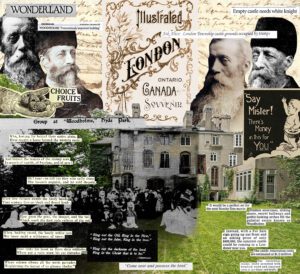
Large download with high-res art. Each collage has a detailed explanation and sources to help you learn more about Woodholme Manor in Hyde Park, London, Ontario.
What can you do with a CURL Fellowship? Just ask Julia Hoytema!
While many scholars have explored gothic literature as a representation of settler anxieties—the “untamed” wilderness as the Indigenous “other” and ghosts as buried truths, for example—relatively little has been written about Gothic architecture as a similar representation.
With support from her Faculty Mentor, Dr. Daisy Raphael, and using Woodholme Manor as a case study, Julia has created both a scholarly paper and a set of educational collages exploring how the concept of haunting has been used within settler-colonial studies to discuss the violence that is inherent to settler-colonialism. “In this framing, ghosts are created when the state attempts to bury this violence in the past,” says Julia, “Presenting it as a historical event rather than an ongoing process.” With support from her Faculty Mentor, Julia composed a paper theorizing how architecture can produce metaphorical hauntings within settler-colonialism, visually communicating occupation and alleged settler ownership of the land.
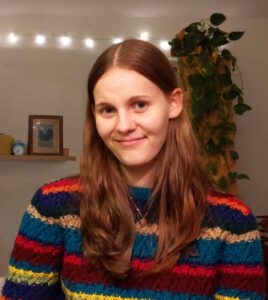
“I thoroughly enjoyed my CURL Research Fellowship and feel … that I gained a lot of skills and knowledge from [it],” Julia shares. “Most of my research prior to my Fellowship was for class assignments, and this project allowed me to take a much more in-depth approach…. I improved my writing and research skills, and I was able to do archival research for the first time as well.”
Taking on the Fellowship allowed Julia to explore the challenges that often come with immersive research in a safe way. “My original topic was very broad, and I realized that the project was becoming unmanageable,” she recounts. “I had to narrow the scope of my project, which led me to choose only one case study to focus on. I wanted to make sure that my resarch would still align with the original goals I proposed, and I feel that using Woodholme Manor … allowed me to do this.”
Dr. Raphael, Julia’s Faculty Mentor, was hugely supportive throughout the project. “She provided lots of feedback while I was revising my research questions, worked with me to find out what the most important parts of my research were, and helped with editing and refining my writing.. I’m very grateful for her mentorship and guidance, and I would strongly recommend a CURL fellowship to any student who is considering one.”
Julia credits her CURL research as an inspiration for her future Master’s thesis: analyzing the work of Dominion Architect Thomas Fuller as an example of settler-colonial nation building in Canada.
Congratulations on your wonderful project, Julia, and best of luck as you submit your paper to journals!