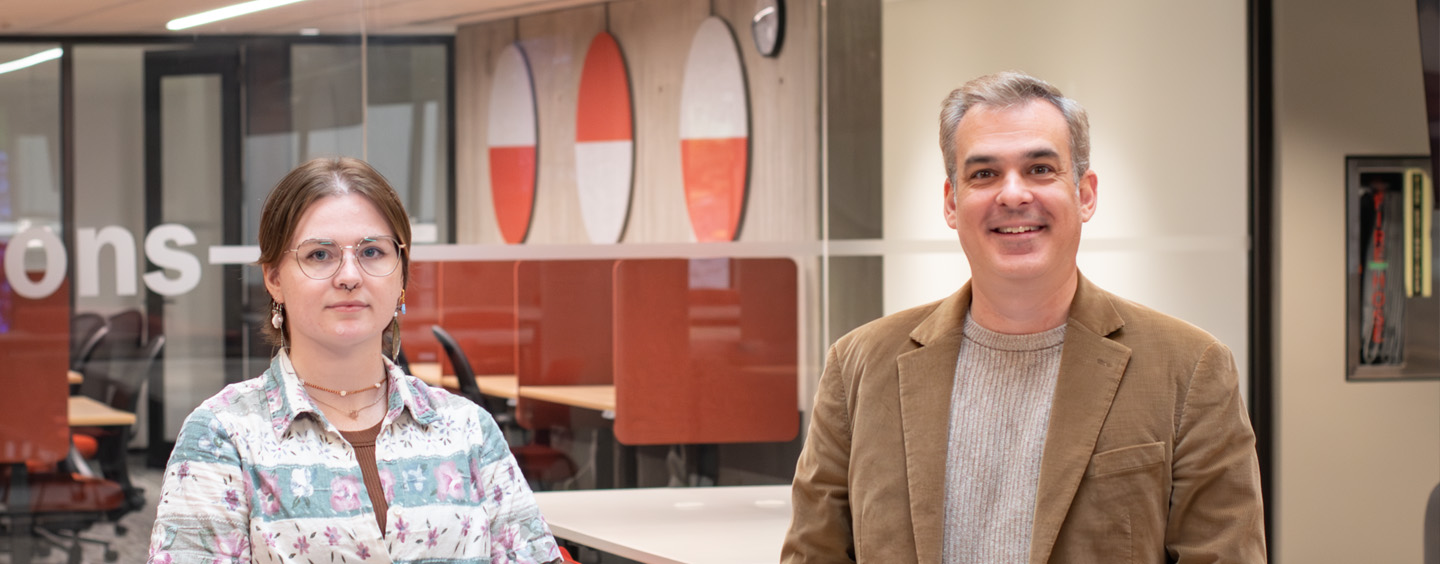
OHEP1 Guest: Dr. Tim Compeau
Episode Transcript
OHS01E01 Intro
[Dr. Compeau] I love these intimate stories of individual lives, of families that are facing these incredible historical moments. But I’m also really fascinated with the imperial structures, the way that empires move people against their will as willing migrants, how empires move stuff, commodities, how empires move disease and mail, so these big networks fascinate me, but I also love the intimate individual lives. And so, I find myself from project-to-project sort of veering from one to the other.
[Madison] Hi, I’m Madison.
[Olivia] I’m Olivia.
[Varun] And I’m Varun.
[All] And we’re your hosts of Office Hours Season 2.
[Olivia] What’s Office Hours Madison?
[Madison] Oh, good question, Olivia. Office Hours is a monthly podcast produced by us, your peer research coaches, and the Huron University Library, where research takes center stage. Each month, we interview a professor at Huron to hear more about what they are up to.
[Varun] Varun 0 Oh, oh, and don’t forget, we also talk to undergraduate students each month about their own research project in our Student Spotlight episodes.
Before we dive in, we want to acknowledge that we are bringing you this podcast on the land of the Dishkan Zibing Anishinabek, Chippewas of the Thames First Nation, Luna Peiwa, Mansi, Delaware Nation, and Onyota Ka Oneida Nation of the Thames. We encourage you to read our full land acknowledgement on the Office Hours website or the show notes to learn more about the lands that Huron occupies and get informed about indigenous news and resources.
Full Land Acknowledgement and Local Indigenous News & Resources
OHS01E02 Transcript
[Madison] Hello, and welcome to the first episode of Office Hours for this school year. I’m Madison, your host of today’s episode, and joining me in studio is Dr. Tim Compeau.
Dr. Compeau is a history professor here at Huron with research interests in revolutions, Upper Canada, cultural, military, and global history, and public and social memory.
Anything else to add, Dr. Compeau?
[Dr. Compeau] No, that sums it up. Thanks for having me.
[Madison] Quite a wide range and a lot to dig into, so let’s get into it.
So, to kick things off, can you share a bit more about what the focus of your research is and what types of projects you are working on?
[Dr. Compeau] Yeah, so I research broadly the British Empire from, say, the 1760s, sort of the end of the Seven Years’ War, through to the end of the Napoleonic period, 18-teens, 1820s, that kind of era.
My main focus has been, for the past few years, the loyalists of the American Revolution, and then what happened to them during and after the war. So, I had a book come out two years ago now about their experiences in the conflict and sort of their afterlives in the British Empire.
And then right now I’m working on a biography of a loyalist exile who came from Connecticut and ended up in Canada, but really, he went on a sort of odyssey throughout the British Atlantic in the 1780s and 1790s.
And then I’m working on a website called Loyalist Migrations, which is an attempt to sort of trace and visualize the human migrations, the exiles, the people that left from the United States in the aftermath of the American Revolution.
[Madison] I did notice quite a few of the journal articles on your Huron Staff page are about technology and history, specifically augmented reality and how it could be used to teach people to see the past like a historian.
I have two questions. One is relating to this. How do you see the future of historical study going as technology continues to advance? And then what is seeing the past like a historian to you? How would you say that way of thinking is different than just thinking about it?
[Dr. Compeau] OK, well, those are two big questions.
So that research I wrapped up in 2019. And the one lesson I learned from doing all of that is how quickly technology changes and how hard it is to keep up with it and keeping your research and your output relevant.
So, I started doing research on augmented reality way back. It must have been in 2012, I think. And augmented reality, for those of you who don’t know, is the overlaying of digital information, digital content onto real world environments through screens. So, the best example of that is your backup camera that shows where your car is steering and the lines of that, of which way your car is going.
And so, I started working with a professor here at Western named Rob McDougall way back when I was a PhD student studying some of the implications of augmented reality as a disruptive technology for public history. How is this going to change how we go to museums, how we look at artifacts, how we interact with historical sites?
And perhaps there was ways to sort of have a subversive kind of commemoration. Okay, here is a plaque. The plaque gives one version of history. But if I put on my historical AR goggles, perhaps it’ll tell me a competing form, a form that centers on decolonization or anti-racism, some kind of alternative story of the past.
So, I worked with Professor Kevin Key, who is at Brock and is now at Ottawa, producing a collection called “Seeing the Past with Computers,” which looked at both AR and computer vision. Now, at this point in my career, looking back at AR, it almost seems quaint because we’ve moved on so much so fast since then. And AI, not AR, is the new big thing. So, I think I’ve sort of left AR behind and haven’t really touched it in quite a few years.
But that taught me a lesson, though, in the sense that this was pegged to be the new big thing. This was going to be the disruptive technology. Get on board right now. This is going to change how your museum works. And it didn’t. And so I think that’s an important lesson, whether or not I don’t think AI is going to have that kind of fizzle out kind of experience. But who knows, right? And so this has made me kind of a digital skeptic in some ways of the new thing.
But I still think, to your second question, that the study of AR is helpful in that sense of seeing the past like a historian. So, when I visit a new city, when I even go downtown London and look around, I see street signs and it kind of triggers something for me. Like, oh, there’s Victoria Avenue, or there’s Trafalgar Street, or, you know, different places, things that just might be part of the environment. But they are filled with history.
And the history, it informs so much of how the city is built, the ideas that are sort of impregnated into it. So, seeing like a historian is seeing the past all around us and how it shapes our landscapes, how it shapes our present, how it shapes our relationships with people, where we live in the city. And augmented reality was sort of a way, a theoretical way, I suppose, of imagining putting goggles on people’s heads to let them see all this historical information sort of pinging off in real time. We never got there, but that was the idea.
[Madison] So it sounds like it was a way to, I guess, show people how somebody that is used to seeing the past, like a historian, would typically see stuff. I guess, give them a view into that world, whereas they might not usually just see a street sign and think of all the history with that.
[Dr. Compeau] Yeah, exactly. Like, not everybody, in fact, most people do not spend every waking hour thinking about history, reading history, so they don’t become equipped with all that sort of knowledge in their heads.
So, this is what, that was the idea that we could, you know, create a system that would allow people to see that.
[Madison] That is very cool.
[Dr. Compeau] And we did try a couple examples working with groups at Brock University. They had worked on projects at the Battle of Queenston Heights and Niagara-on-the-Lake that were sort of gamifying, making apps, gamifying sort of history. But as you walked through the town, you know, different historical sites, plaques, old ruins, things like that, with sort of monuments, with sort of lighthouses. Monuments would sort of light up on their app and take them along this route of historical tour.
[Madison] So, can you tell us more about your research journey from the time you were a student until now?
[Dr. Compeau] Yeah, it’s a long story. Since I was a little kid, I was always interested in history. I remember when I was probably nine or ten, my parents were like, you know, where would you like to go on holiday?
We can go to Disneyland, we can go to here. I wanted to go to Colonial Williamsburg, and so that was a formative experience for me to see, sort of, that site of the American Revolution, the way that historical site comes alive.
So, things like that were really important for, I guess, firing a zeal to want to study history every chance you get. But specifically for what I do now, so I grew up in a little town called Gananoque. It’s in eastern Ontario. It’s on the Thousand Islands and the St. Lawrence River. And when I was just at the end of high school, so it would have been the summer after I graduated, I took a job at the little museum that was there. And this museum at that point was kind of crumbling. The collection wasn’t well maintained. It was a real mess. And that was so much fun because I was allowed to just sort of roam through this collection and look at whatever I wanted to and try and build exhibits with really no knowledge about anything. It was just sort of, you know, getting paid minimum wage as a high school student.
And then in one of those sort of days of just sort of wandering around this little museum, I came across a suitcase and it was full of letters, really old letters, still folded in the little way that they would have been sent in the 1700s. Some of them still had little bits of wax on them. And there was about 20 or 30 and they were all letters from the town’s, from the town founder to his family back in Connecticut. And I was really struck by these, obviously. A, just because they were so old. B, I could sit down and I could read them. And there were this tangible sort of connection with the deep roots of the community where I lived. And it was also a mystery. Who were all these people he was talking to? What were their connections to him? And that was 25 years ago. And that started me on this path of just the love of getting into the archives, of seeing the original papers and documents and letters.
So that in general, but then the story of the Loyalists that left the American Revolution, and also the War of 1812, and then the bigger picture of the British Empire in which all of these things are situated.
And so, when I did my undergrad, you know, you take, I took a lot of global history, I took a lot of international global history. I took a lot of American history and British history across the board. And then when I began my MA, my master’s in public history, I was really focused on at that point, I wanted to be a museum curator, and I wanted to make history accessible to the public. And I wanted them to really get as excited about it as I was. And so, my project during my MA, so when you do your MA in public history, you do coursework and then you do either a cognate or an internship. And so, I kind of did both. I worked as an intern for Professor Bill Turkel. And then I was writing this big cognate essentially on this Loyalist that I had come across. His name was Joel Stone, he was accredited as the founder of Gananoque. And so I made a website, an online exhibit, and then did a museum exhibit back home. And so that’s where things got started for me.
And then I can’t remember exactly how I got talked into doing the PhD, because that was not really what I wanted to do. I wanted to be a public historian, I wanted to be out in museums with the people. And at any rate, I ended up back at Western. And when I was doing my MA, I’d met Nancy Roden, who is their 18th century British Atlantic specialist. And so I came back to work with her on a PhD, but also keeping a foot in the world of public history. So, I kind of joke that I did two PhDs. On the one hand, I did my dissertation, which was on the Loyalists and their migrations. And then on the other hand, I did all these extra research projects that weren’t really part of the PhD on AR, on gaming. And so, kind of two threads there. And then when I finished my PhD, I did a, as I mentioned earlier, I did a postdoc with Kevin Key at Brock, and then got a job at Huron.
And I’ve been here ever since. But it’s actually kind of fun, because right now I’m working on the full length biography of that Loyalist, Joel Stone, who I first encountered in the archives, or in the in the Gananoque Museum. So that’s 20 plus years on, I’m finally getting back to writing his story properly. And so that’s what I’m, that’s what I’m working on, right now, in addition to the Loyalist Migrations Project. And then I’m working on the full-length biography of the Loyalist and their migrations project.
[Madison] So would you say you kind of started with a narrow focus on what you wanted to do, and then it expanded out and then you kind of found yourself narrowing your study area back down to that one Loyalist?
[Dr. Compeau] I would say it kind of, it stretches, and it comes back. So, when I started the PhD, no one told me I couldn’t do a biography for my PhD, it just didn’t seem like the right thing to do. So my PhD dissertation, which became my first book, is more of a general discussion, or a general history, of the Loyalists. And then now I’m kind of getting back that I’m more established, I can write this biography and have fun with it. So, in many senses, I’ve started narrow, went expansive, I’ve narrowed it back again. And I think that’s how my career will go.
Because the other thing that I’m really interested in, is to be able to have these intimate stories of the individual lives of families that are facing these incredible historical moments. But I’m also really fascinated with the imperial structures, the way that empires move people against their will, you know, as willing migrants, how empires move stuff, commodities, how empires move disease and mail.
So, these big networks fascinate me. But I also love the intimate individual lives. And so I find myself from project to project, sort of veering from one to the other.
[Madison] When you’re doing research into an empire or into individuals’ lives that may have been affected by this, and it’s potentially on a group that may not have many primary sources, either because they were destroyed or not seen as valuable to keep, or an opposing force just wanted to get rid of their history. How do you go about finding information?
[Dr. Compeau] Oh, it really depends on the topic and the subject we’re talking about.
There’s a couple things. Now, I would suggest that historians that are doing sort of 18th century work always have an ancestry account, you would not believe the little clues that you can pick up by looking at family trees and by genealogies. And so, I think in the world we live in now, in which genealogy is such a big deal, and so many people are working on it, that historians are, or should be. I am really grateful for all the work that citizen historians, family historians are doing, because you never know the kinds of little tidbits that they’re going to pull out that you can then follow these clues.
I’ll give you an example, though, of one things I’m working on right now, which I’m quite excited about. I’m reconstructing a Tory plot, a loyalist plot in one corner of Connecticut. This was something that the people involved were deliberately trying to keep secret. They did not want this information to come out, but we know it happened because of a letter that was submitted to the British government in 1784 that is basically a testimony saying, yeah, Joel Stone, this character I’m looking at, he helped me escape from jail. And so this
This guy who was being held in, well, he wasn’t in jail, he was in some guy’s house, but he was essentially imprisoned. And his name was David Matthews, and he was the mayor of New York. And we don’t know really what he was up to. It’s a big mystery. He was either part of a plot to try and kill George Washington, or to try and kidnap George Washington in 1776. Either way, it was bad.
And so the guy I’m studying, he has a letter in his file in the British government records that say he helped this guy escape, and therefore he is worthy of compensation and reward by the British state. But how did this actually play out? How did he do what is sort of confirmed in this letter that he did? And so I’m gathering up all the letters that sort of passed at this time, and then finding newspaper, little tiny snippets, David Matthews has arrived back in town after six months in imprisonment. And that’s on December 3, 1776. And sort of, first of all, trying from these little teeny tiny clues, rebuilding the chronology, and then to look at little clues in their letters.
So this is giving a little bit away from the book. But at one point, you can see that the mayor is complaining that he has no winter clothes, it’s going to get cold here, I need to talk to a merchant, I need to talk to a local merchant to give me clothes. Well, Joel Stone was the local merchant. And so, you begin to start seeing, okay, I get now how they are finding ways to communicate with each other. Is it 100% sure? No. Is it plausible? Possible? It seems that way. And little tiny clues like that, that you can then use to build a bigger picture to build a better picture of a plausible picture of how this came out, because we’ll never know for sure. But it’s a lot of fun to try and piece together these clues.
Finding the small clues, I think, and even the idea that they’re perhaps fit into it, I think, would just make it worth it, because I think it’d be so satisfying to even be able to say that you have a somewhat, maybe kind of clearer, picture of it. So, a large focus of this podcast is to help undergraduate students learn about the research and interests of faculty members and also the various potential relationships between faculty research, and independent undergraduate research and learning.
[Madison] Can you share some of your thoughts on what impact extracurricular research can have during your undergrad?
[Dr. Compeau] Well, it could be huge. Because it’s an opportunity to do research that you’re not getting marked for. And some students might hear that and be like, well, why would I bother? Right?
[Madison] Right.
[Dr. Compeau] But it is an opportunity to do research in a kind of pure way, right? You’re not doing it to please anybody. You’re doing it to produce research that is intended for some audience. It doesn’t just stop with the professor. It doesn’t disappear at the end of the course. You can always point to an exhibit or a publication or a website or something like that and say, look, there is my work. That’s what I did. And it’s part of the historical record now. And you’ve contributed to that.
So, I think that is an amazing opportunity. And in the history department, we’re very fortunate. Nina Reid-Maroney has her Phantoms of the Past projects that she’s worked on. And she’s been able to hire on many student researchers to help her with her work. I know Professor Peace, the same with his indigenous research and hidden histories. And then every year since 2019, I’ve been fortunate to be able to hire on an RA every summer to work on Loyalist Migrations.
But Huron in general also has CURL, which I’m sure you’ve talked about on this podcast before. And I’ve supervised CURL students. And that’s going to be, that’s a lot of fun. And I had a student a few years ago work as an embedded researcher in a kind of an old-timey anthropology way. So, I think that’s a great opportunity. And I think that’s a great opportunity with historical reenactors and finding out why they do what they do, how they do it, the value of it for public education and for their own sort of edification as hobbyists.
And yeah, the extracurricular research is something that I never had an opportunity to do until I got to grad school. And then I took advantage of it. And it was really enriching as a scholar for its own sake. But then it’s also great for when you’re applying to jobs, when you’re out in the market, and you can point to these things and say, “Look, I’ve done all this work, not just in class, but I’ve actually applied what I’ve learned in class to real research.”
[Madison] So, if a student’s interested in pursuing history for their undergrad, what are the specific challenges they should be aware of, either with the extracurricular research or just, I guess, in general learning how to do stuff like a historian, for example?
[Dr. Compeau] Well, I think the challenges for doing a history undergrad are the same for any undergraduate degree, I suppose. It’s about managing your time. It’s about making sure you apply yourself, listening to feedback and growing from that. I think history can be tricky for some students because it is so open-ended.
My colleague, Tom Peace, refers to history, and I think he’s right, as the interdisciplinary discipline. And so, if you are a psychology major and you’re doing a history minor, you’re doing a history course, most of myself and most of my colleagues, we would encourage you to sort of use that lens of psychology, the methodologies that you might have there, and bring them to the table. What can psychology add to the study of history? What can economics or anything?
And then so as a historian, too, one of the tricky things, one of the hard things is what’s your approach? We’re all empiricists. We’re all using the evidence that we find in the archives, but how are we going to interpret it? And so that open-endedness can be tricky. And then history isn’t for everybody because it is so big, and you have to have the ability to take in a lot of information and be able to process it and to make it coherent. And that requires a kind of diligence, but also curiosity. So, all of those things are opportunities for students who have those qualities in history, but they can be challenging too.
[Madison] What’s some advice you would share with a student about how to manage their time when they’ve got all these projects and assignments on the go?
[Dr. Compeau] Well, yeah, time management is something I wish I knew how to do better. I’m always racing towards deadlines. And I think that’s part of the life of a historian. But basically, just keep a calendar, keep a schedule and stick to it. But in terms of the extracurricular research, talk to your supervisor, students who work for me.
Um, you know, your courses do come first, right? You do want to get those good grades. And so, if there’s a conflict with something that I might want a student to be working on and their final exam, the final exam is going to win. But I need to know about that. So, a good communication with your supervisor is probably number one in order to maintain the balance.
[Madison] I think with communication, you can almost solve almost anything, to be honest, when it comes to coursework.
[Dr. Compeau] Absolutely.
[Madison] So, moving into something, I guess, a bit more casual, we have some rapid fire questions for students to get to know you better as a person. This is a very important one. Okay. What’s your favorite animal?
[Dr. Compeau] I like big cats, snow leopards, tigers, lions, all that stuff.
[Madison] Very cool. What do you do when you’re not preoccupied with history?
[Dr. Compeau] It’s my life. I’ll watch history documentaries. I like historical fiction. I do. To really, wind down, I will cook something elaborate, a curry, something like that, and stare at the window.
[Madison] I guess that’s a way to wind down.
[Dr. Compeau] Yeah
[Madison] What’s your favorite kind of weather?
[Dr. Compeau] Weather? I like a good, crisp fall day.
[Madison] I agree. Today is great, minus a bit of the rain, I think.
Are there any subjects you want to learn more about outside of history, if that’s even possible, I guess? Because if you’re viewing it from a historical angle, you’d probably also think about history in general, too.
[Dr. Compeau] Yeah. Topics outside of history, I’ve always been fascinated. Well, that’s kind of a cop-out. I was going to say anthropology, but that’s so close that I’m not going to… There was a time when I wanted to be an archaeologist. So, all that kind of stuff, the science side of studying the past, I love.
I wish I knew more about music, and I have always struggled with languages. I took a bit of French when I went to my undergrad, because to get a PhD, you have to be able to get by in a second language. However, in the decades since I got the PhD, I’ve not really spoken French or practiced French. And so, I finally started to look at that again and regain my footing in French.
[Madison] I relate to you on the language aspect. I took German.
[Dr. Compeau] Oh, really?
[Madison] And it was quite a daunting task, and I’ve managed to pass with a 50 in the exam, I think.
[Dr. Compeau] Yeah. I think I did Latin in my first year, which are very similar, in some ways. And I didn’t do that well.
[Madison] It’s pretty hard to do everything, I think, in a language, because that’s just such a different part of your brain, I think, that it’s just so hard to, I think, grasp sometimes, for me at least.
[Dr. Compeau] And you can’t, yeah, you can’t fudge it.
[Madison] You either know it or you don’t.
Well, thank you so much for joining us today. It’s been great to talk to you and learn more about your research.
And finally, do you have any words of wisdom or just general advice for undergraduate students, anything you want to close out with or say to them?
[Dr. Compeau] Well, thanks for having me. This has been great.
In terms of advice, I think let’s go back to that communication. Talk to your professors, ask them questions. In terms of, you know, finding opportunities to do research outside of class, the only way you’re going to do that is to speak to your professors and find out what’s coming and what opportunities they have available. And so, yeah, that would be my number one thing is communicate, talk, and keep in touch.
[Madison] I agree. Again, thank you so much for joining us.
[Dr. Compeau] Thank you.
Welcome back to the Office Hours podcast!
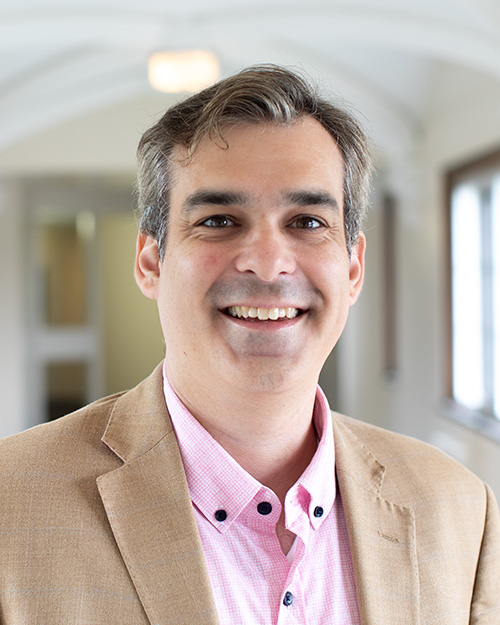
In our first episode of season two, Madison welcomed Dr. Tim Compeau to discuss his lifelong fascination with history and the many projects he has worked on throughout his career. Dr. Compeau shares how his love of history began at a young age and grew as he experienced the wonder of close encounters with historical artifacts as a young adult working at his local museum. His experiences led to a career researching revolutions, Upper Canada, cultural, military, and global history, and public and social memory.
Notably, Dr. Compeau shares some important insights into the value of extracurricular research for undergraduate students:
“…it is an opportunity to do research in a kind of pure way, right? You’re not doing it to please anybody. You’re doing it to produce research that is intended for some audience. It doesn’t just stop with the professor. It doesn’t disappear at the end of the course. You can always point to an exhibit or a publication or a website or something like that and say, look, there is my work. That’s what I did. And it’s part of the historical record now. And you’ve contributed to that.”
Join Madison and Dr. Compeau to hear more about the fascinating projects that Dr. Compeau has worked on including creating immersive historical experiences through AR, research on Loyalists of the American Revolution, and advice for any students interested in diving into more historical research.
Projects and Resources Mentioned in this Episode
Centre for Undergraduate Research and Learning
Professor Tim Compeau’s “Loyalist Migrations” project
Professor Nina Reid-Maroney’s “Phantoms of the Past” project.
Dishonored Americans: The Political Death of Loyalists in Revolutionary America by Tim Compeau
Seeing the Past with Computers: Experiments with Augmented Reality and Computer Vision for History Edited by Kevin Kee and Timothy Compeau
OH Land Acknowledgement & Indigenous News and Resources